
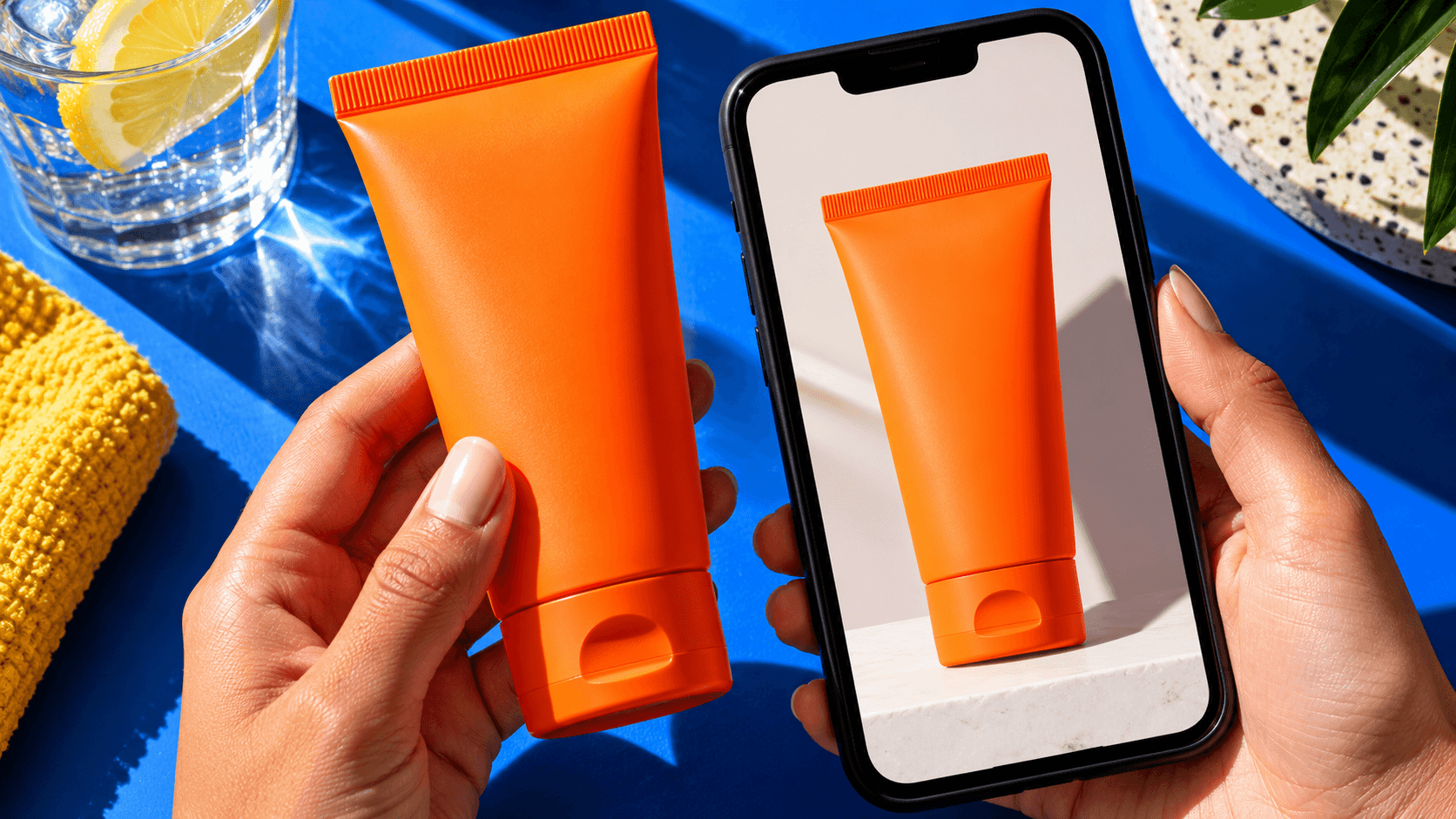
Phygital marketing is physical plus digital in one customer journey — not two separate campaigns. A life-stage brand puts a real product in someone’s hands (clinic, school, campus, home), then continues the relationship on owned channels: guide, Online Platform, CRM, loyalty and targeted email. That is what brand managers usually mean when they search for “phygital marketing,” and it is how START is built in Southeast Europe.
If the brief only buys impressions, you get reach. If it only hands out samples with no digital path, you get a sunk cost. Phygital asks for both halves in the same plan.
What “phygital” actually means
Amazon Ads summarises the origin clearly: phygital was coined in 2007 by Chris Weil (then of Momentum Worldwide) as a blend of physical and digital, describing experiences that fuse the tangible and the virtual. Phygital marketing, in that framing, is a strategy that combines physical and digital elements so customers move across touchpoints without losing the brand thread.
Academic work pushes the same idea further. Batat’s 2022 paper in the Journal of Strategic Marketing argues that phygital should not be reduced to “another word for omnichannel.” The proposed phygital customer experience (PH-CX) framework treats offline and online as a continuum of value — customers shifting from physical to digital settings (or the reverse) while the brand still answers tangible needs (quality, trial) and intangible ones (emotion, trust).
Qualtrics puts it in plain CX language: a phygital experience might start in a physical place with consideration, then move into digital to complete, learn or recommend — and the risk is dropping people in the handoff. Omnichannel discipline exists so that handoff does not break.
Why the physical half still has to be real trial
Phygital fails when “physical” means only a poster with a QR code. For FMCG and family categories, the physical half that moves share is diagnostic trial — enough product to learn — at a moment when the shopping list is open. USPS OIG research with Temple University’s Center for Neural Decision Making found physical ads left stronger emotion, better week-later memory and purchase-intent signals than digital ads, while digital was faster at first exposure. Sampling research adds what media cannot fake: Arbitron / Edison’s Product Sampling Study found 35% of tryers bought on the same trip and 58% said they would buy again; EventTrack 2015 found try-first was the main reason experiential visitors purchased.
What trial does to purchase
So the phygital sequence for a life-stage brand is usually: trusted physical moment → product in hand → keepable guide → consented registration → Online Platform / CRM / loyalty / targeted email.
The START complete experience
What a phygital brief must specify
- Life-stage moment for the physical trial (pregnancy, newborn, school, campus, seniors…)
- Sample format and kit context — enough product to learn, not only a logo sachet
- Guide: print, digital or both — the keepable bridge between trial and online
- Digital layer: Online Platform, QR or registration path, content after distribution
- Consent under GDPR: freely given, specific, informed, affirmative — before the first CRM send
- KPIs for trial and for digital follow-up — not impressions alone
Phygital marketing in START
START by Care Direct is life-stage phygital marketing in Southeast Europe: Greece, Cyprus, Romania, Bulgaria and Serbia. Each program is a complete experience — sampling that expands digitally into Online Platform, CRM, loyalty and targeted email — not a sampling invoice with a “digital” line bolted on later.
Open the programme that matches your buyer’s life stage, then join a START with physical sample specs and digital requirements in the same brief.